Blog Archive

Showing posts with label street. Show all posts

Tulip Refresher Course

I know that some of you guys/gals are more the follow the course tape type of people, so this "race" will be a change. The course will be given to you in two halves. You'll get tulip notes at raceday sign-in for the first half of the race. Once you get to the Zumbro Falls checkpoint you'll receive the instructions for the second half of the race. Approximate size of the notes will be 4.25" x 5.5" (maybe a bit smaller).

Each instruction will include an instruction number, an overall mileage, a tulip diagram and an information cell. The overall mileage will count up from the start or any place where you are instructed to reset your mileage, such as a checkpoint.

The tulip diagram is a graphical representation of the location for the instruction. Normally this is an intersection of two or more roads, or a feature of a road. The tulip always has two features, the dot and the arrow. No matter how the tulip is oriented, you always will travel from the dot to the arrow for that instruction. Normally the tulips are drawn so you are traveling from the bottom of the tulip, but this doesn't have to be the case.

Here is a sample note:
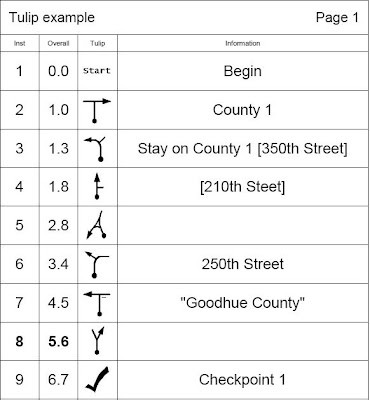


The first tulip of instruction 1 ("Begin") shows that the mileage is zero, so you would want to zero your odometer at that instruction.

The 2nd shows that you will approach a T intersection (in this case it's County road 1) and take a right. This intersection is aproximately 1.0 miles from the last zero.

The third instruction shows that the road turns left, with another road branching off on the right. When a road is in brackets, ex. [350th street], it is indicating the intersecting or connecting road, but NOT the road you take. So in our example above, we stay on County 1 which bends to the left and 350th street intersects from the right.

Instruction 4 is similar. Since 210th street is in brackets [], it indicates the intersecting road is 210th street, but the tulip shows we keep going straight.
!! When in doubt, always follow the tulip and ignore the street or road names provided.

Instruction 5 shows a more complex intersection that we approach from the bottom right and end up taking a hard left a the delta.

Instuction 6 shows that the road we are on bends right, but we take 250th Street that intersects from the left.

When information is in quotes and a small dash is shown on the tulip, as shown in instruction 7, it indicates the text that is on a sign. That sign will be where the dash is shown at the intersection.

Instruction 8 simply shows that we take a right at a Y intersection and that intersection is at approximately 5.6 miles from the last odometer zero.

Tulip 9 shows the location of a checkpoint.

In summary, the text is normally there to provide or clarify the instruction, but the primary thing you should focus on is the tulip. 
Always travel from dot to arrow, no matter how the tulip is oriented on the page.


Taken from http://ragnarok105.blogspot.com/

Cue sheets 101


Our route instructions are listed in a 4 column format. Each instruction will include an instruction number, a mileage, a 'tulip' diagram and information. The mileage will count up from the start or any place where you are instructed to reset your mileage, such as a checkpoint.


The tulip diagram is a graphical representation of the feature for the instruction. Normally this is an intersection of two or more roads, or a feature of a road. The tulip has two features. The dot and the arrow. No matter how the tulip is shown, you will travel through the intersection from the dot to the arrow. Normally the tulips are drawn so you are traveling from the bottom of the tulip, but this doesn't have to be the case. Note: all mileages are rounded to the nearest tenth of a mile. Example:


Instruction 1 is at mile 27.2. The diagram indicates caution is required at that location and the info describes why.

Instruction 2 is at mile 27.3 and it indicates that you are to take a right at a 4 way intersection and end up on Water street.

Instruction 3 shows a more complicated intersection where 3 roads meet. Here you would take the 90 degree right onto 355th street.

Instruction 4 indicates you should continue straight past an intersection with 200th street. When a name is in square brackets, it indicates the crossing street or road.

Instruction 5 shows one of the "King of the Mountain" locations. We will score the first several riders to this location for that competition. For the following riders, this location doesn't mean much, other than the top of a hill.

Instruction 6 shows that the primary road curves left, but you will take the secondary road to the right. In this case, the secondary road is 380th street.

Instruction 7 shows a turn onto a Minimum Maintenance road. The dashed line indicates the road is a less prominent road than a regular road.

Instruction 8 shows a checkpoint. At each checkpoint, make sure the person working that location has your number before you leave. You may also need to get a new set of cue notes at that location.

In summary, the text is normally there to provide or clarify the instruction, but the primary thing you should focus on is the tulip. Always travel from dot to arrow, no matter how the tulip is oriented on the page.


Taken from http://ragnarok105.blogspot.com/

CRUCIAL LIFE LESSONS LEARNED AT STREET LEVEL


They say you’re built upside down when your nose runs and your feet smell, so forgive me today for dipping into the “archives” while I battle the remains of a pesky flu that, like our gang problem here, refuses to go away.
Given that the Special Olympics B.C. Summer Games started last night in Abbotsford and runs all weekend, this “encore presentation” seems appropriate:
My former neighbour Kevin, once the Roberto Luongo of winter street hockey in Yorkton, Sask., would be high-fiving my folks today if his kind heart didn’t stop beating three days shy of his 16th birthday.
Later this evening, Kamloops Immigrant Services will award 19 people – including this shocked scribe – with a Community Diversity Award. If truth be told, my mother’s name, not mine, should be inscribed on that cherished certificate.
Adele Mildred Kurenoff, my awesome mom, taught me early, and often, about tolerance, goodwill, compassion and decency. (She joked that these things didn’t apply in today’s workplace.)
She also taught me to not let the ignoramuses of the world hijack my outlook or lofty dreams. And, more importantly, she forced me to play street hockey with Kevin when nobody else in our small Saskatchewan neighbourhood would.
Kevin was mentally challenged. We looked at him, as naive kids would, as being very different. And odd. And weird. We never asked him to join our hockey games, even though it was he who often got up earlier than Prairie roosters and shovelled the one patch of road to make the entire exercise possible.
Mom asked one morning why Kevin wasn’t allowed to play. I confessed nobody wanted him to join us. Visibly upset with me for going along with the “lame-brain majority,” she ordered me to change that the next time we played – “or else!”
Well, when I picked Kevin for our team, the other kids on the street mocked me big time.
“Kurenoff, are you completely nuts?” yelled the neighbourhood mouthpiece, encouraged by the others’ non-stop laughter and catty shots.
“No. We’re both nuts,” Kevin blurted back unexpectedly. “And we’re going to beat you boys bad!”
What we didn’t know until he played was that Kevin could stop lightning from getting past him. It didn’t take long to figure out that the team with Kevin playing goal usually won. Darn neighbour even got cocky about his near-perfect record. When he passed away, the church was filled with his ragtag “hockey buddies.” His foster mom thanked each of us for making a much-too-short life full of so much joy.
We all got seriously choked up when she told the funeral gathering that Kevin thought “we were all pretty odd, lousy goal-scorers, but the nicest friends in the whole wide world.”
When my first editor – Dick DeRyk of Yorkton This Week – molded me into a weekly columnist, he explained that people sitting behind a keyboard have a lot of power and responsibility. Used incorrectly or dishonestly, our words could become weapons of mass destruction. Just like closed or narrow minds.
My mother encouraged me to use this special privilege to make people smile, to make them think and eventually make them tolerate everyone around them who may be different. Like Kevin.
My mom continues to encourage these columns. Allow me to offer loving thanks to her for removing my blinders and, of
course, a big high-five in the sky to the best street hockey goalie I ever knew.
Rest in peace, Kevin. This award’s for you buddy.

Gord Kurenoff is editor of the Abbotsford-Mission Times. He was a nominee last fall for an Abbotsford Diversity Award. To comment, e-mail letters@abbotsfordtimes.com.


Taken from http://myextratwobits.blogspot.com/

Some final notes


  • A front and a rear light is required to be on at all times on the course.
  • A Helmet must be worn at all times progressing down the course.
  • You really should have a computer to help with navigation.
  • A fully charged cell phone is also a very good idea. You will need some way of contacting the outside world. We will not look for you if you don't make it to checkpoints.
  • Rain jackets/pants/whatever you need to traverse 100+ miles while in possibly drizzly, possibly windy, probably cold (think 35-40 degrees) weather.
PLEASE note that Colvill Park currently does not have any open bathrooms. As you head into town please take advantage of the many convenience stores or fast food joints to make that pit stop.

Here is a google link of key points - start and checkpoints

Some directions to Colville park (note that you'll want to go through town if you want to go to the bathroom):


Coming into Red Wing from the north on

US Hwy
61

Once in or near Red Wing take Highway 61 through town towards the south.
Outside of town about 1.5 miles, you will want to exit the highway to the right (there is a sign for a city park).

(This is the first and only exit south of town on the 4 lane stretch. If you get to where the road goes back to 2 lanes, you just missed your turn. If you miss it, take the very next right hand turn into the correctional facility [MN 252], drive through the lot and keep going on that street. This will bring you back to the missed exit)

Take a right on the frontage road and another immediate right onto Nyphara lane.
At the bottom of the hill, take another right under the bridges.
Once in the park, keep to the right and look for the group of cyclists.

Coming into Red wing from the west or south on
State Hwy
58

As you come into Red Wing, after the first stop light, the road will become two lanes at the bottom of a big hill.
Continue on this road as it heads towards downtown on Hwy 58/Bush street. Then you get to

7th Street
, you will take a right onto
7th street

(There is a liquor store on the right and a Kwik Trip on your left.)

Take

7th street
for about 1.5 miles.
When you can see Hwy 61 on your left, take a left onto Nymphara lane.
Take another left at the bottom of the hill under the bridges
Once in the park, keep to the right and look for the group of cyclists. Coming into Red Wing from the south on
US Hwy
61

As you approach Red Wing, Highway 61 will turn into 4 lanes.
Immediately after it becomes 4 lanes, take the exit on the left.
Take a right on the frontage road and another immediate right onto Nyphara lane.
At the bottom of the hill, take another right under the bridges.
Once in the park, keep to the right and look for the group of cyclists.


Taken from http://ragnarok105.blogspot.com/

Tulip Notes 101


Each instruction will include an instruction number, an overall mileage, a tulip diagram and an information cell. The overall mileage will count up from the start or any place where you are instructed to reset your mileage, such as a checkpoint.

The tulip diagram is a graphical representation of the location for the instruction. Normally this is an intersection of two or more roads, or a feature of a road. The tulip always has two features, the dot and the arrow. No matter how the tulip is oriented, you always will travel from the dot to the arrow for that instruction. Normally the tulips are drawn so you are traveling from the bottom of the tulip, but this doesn't have to be the case.

Here is a sample note:


The first tulip of instruction 1 ("Begin") shows that the mileage is zero, so you would want to zero your odometer at that instruction.

The 2nd shows that you will approach a T intersection (in this case it's County road 1) and take a right. This intersection is aproximately 1.0 miles from the last zero.

The third instruction shows that the road turns left, with another road branching off on the right. When a road is in brackets, ex. [350th street], it is indicating the intersecting or connecting road, but NOT the road you take. So in our example above, we stay on County 1 which bends to the left and 350th street intersects from the right.

Instruction 4 is similar. Since 210th street is in brackets [], it indicates the intersecting road is 210th street, but the tulip shows we keep going straight.
!! When in doubt, always follow the tulip and ignore the street or road names provided.

Instruction 5 shows a more complex intersection that we approach from the bottom right and end up taking a hard left a the delta.

Instuction 6 shows that the road we are on bends right, but we take 250th Street that intersects from the left.

When information is in quotes and a small dash is shown on the tulip, as shown in instruction 7, it indicates the text that is on a sign. That sign will be where the dash is shown at the intersection.

Instruction 8 simply shows that we take a right at a Y intersection and that intersection is at approximately 5.6 miles from the last odometer zero.

Tulip 9 shows the location of a checkpoint.

In summary, the text is normally there to provide or clarify the instruction, but the primary thing you should focus on is the tulip.
Always travel from dot to arrow, no matter how the tulip is oriented on the page.


Taken from http://ragnarok105.blogspot.com/